
Is Navigator right for you?
Navigator automatically steers your pension based on your age.
It’s right for you if:
- You’re prepared to take a bit more risk to grow your pension when you’re younger, and less when you’re older.
- You want your pension to stay invested during your retirement and when you’re taking money from it.
- Your retirement’s a long way off and you haven’t quite decided how and when to retire.

It’s not right for you if:
You want to take all your pension on a fixed day, either as cash or to buy an annuity.
Highlights
- When you’re younger, your money’s invested in our Adventurous Growth approach – with higher potential to grow your money in the longer term.
- When you turn 51, we gradually start moving it into our Careful Defensive approach – for more stability, but with slower growth.
- Our experts invest your money globally to give it more chances to grow and to spread the risk.


Remember, the value of investments can go up and down, so you may get back less money than you put in. Tax depends on your individual circumstances and the regulations may change in the future.
How is your money invested?
Up until the age of 51, we invest your money in our Adventurous Growth approach. It’s higher risk but can generate higher returns – and you’ve got plenty of time to ride out the market ups and downs.
When you’re 51, we gradually move some of your money into our Careful Defensive approach each year until you’re 65. This blend of approaches keeps your money growing, while reducing those ups and downs ready for you to start taking it out. Best of all, it’s all done for you.
Percentage invested in each approach by age
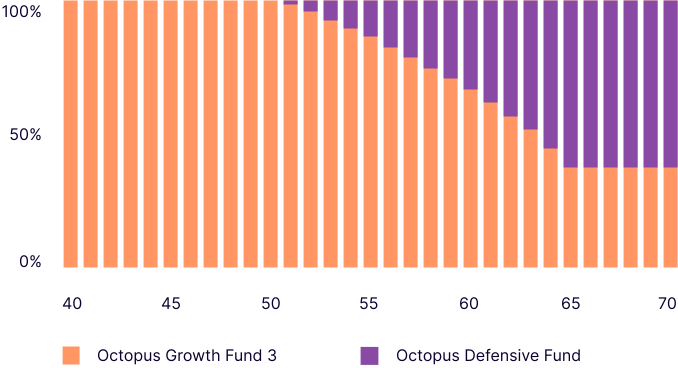

Adventurous Growth approach

Careful Defensive approach
Explore both approaches
Where you money’s invested
This approach aims for higher potential growth over the longer term. Our experts review the mix of investments regularly.
Here’s the detail at 31 December 2025.
Lower risk

1% Cash

0% Short maturity bonds

0% UK Government bonds (Gilts)

0% Global Government bonds

1% UK corporate bonds

3% Global corporate bonds
Higher risk

11% Shares (emerging market)

8% Shares (UK)

6% Real estate investment trusts

64% Shares (overseas developed)

2% Bonds (emerging markets)

4% Bonds (high yield)
What do these terms mean?
Bonds: These are like IOUs, used by companies and governments to raise money. The buyer effectively lends money to the seller, in return for interest on their investment over a set amount of time. When that time’s up, the value is paid back.
Gilts: These are just a type of bond. But instead of lending money to a company, it’s lent to the UK Government.
Shares: A share is a tiny bit of a company. Share owners are called shareholders. If a company does well, shareholders are rewarded with a proportion of the profits, paid out as dividends. The value of shares rises and falls according to the company’s performance, and other factors.
Real estate investment trusts (REITs): These are pools of money gathered by a company from investors. They’re used to buy, manage or invest in property and land (real estate) to generate income – a way of investing in commercial property without needing millions.
How the fund invests
Your money is invested in a group of funds, rather than directly in stocks and shares. This is known as a fund of funds.
Top holdings
The following is up-to-date as of 31 December 2025.

abrdn Evolve World Equity Fund

iShares Continental European Equity ESG Index Fund

iShares MSCI Emerging Markets ESG Enhanced UCITS ETF

iShares MSCI USA ESG Enhanced UCITS ETF

abrdn Asia Pacific ex-Japan Tracker Fund

iShares MSCI Japan ESG Enhanced UCITS ETF

abrdn Evolve American Equity Fund

iShares UK Equity ESG Index Fund

abrdn Global REIT Tracker Fund

abrdn Global Corporate Bond Screened Tracker Fund
What you could have earned already
The table below illustrates the annualised total returns of the fund for the period shown, compared with its benchmark. Remember, past performance isn’t a reliable guide to future performance.
The following is up-to-date as of 31 December 2025.
| December 2020 to December 2021 | December 2021 to December 2022 | December 2022 to December 2023 | December 2023 to December 2024 | December 2024 to December 2025 | |
|---|---|---|---|---|---|
| This fund | 14.8% | -8.4% | 11.0% | 11.7% | 15.0% |
| Performance Comparator* | 15.1% | -8.8% | 13.5% | 16.2% | 12.2% |
This fund launched in November 2020. To help you compare it with other funds we have replicated the performance of the markets the fund invests in, to indicate what the performance may have been prior to its launch. The simulated return takes into account total annual charges of 0.45% and that the mix of assets are rebalanced once per month, but does not include the separate account fee of 0.30% per year.
*The fund doesn’t use a benchmark as a guide for investing or as a target to beat. But we do use a performance comparator which investors may want to compare the fund’s performance against. This comprises 80% shares and 20% bonds. Shares are represented by the MSCI All Countries World Index GBP, whilst bonds are represented by the Bloomberg Global Aggregate Bond Index – GBP Hedged. The fund invests differently to the performance comparator therefore returns will always be different. For example there are differences in the way the fund is built vs. the comparator, along with the cost of investing, which is included for the fund return, but not the comparator. You cannot invest in the performance comparator.
Source: Lipper, year on year, 31 December 2020 to 31 December 2025, bid to bid with net income reinvested.
Where you money’s invested
This approach aims for more stability, but with slower growth. Our experts review the mix of investments regularly.
Here’s the detail at 31 Decemner 2025
Lower risk
16% Cash
19% Short maturity bonds
13% UK Government bonds (Gilts)
13% Global Government bonds
3% UK corporate bonds
14% Global corporate bonds
Higher risk
2% Shares (emerging market)
3% Shares (UK)
1% Real estate investment trusts
10% Shares (overseas developed)
3% Bonds (emerging markets)
3% Bonds (high yield)
What do these terms mean?
Bonds: These are like IOUs, used by companies and governments to raise money. The buyer effectively lends money to the seller, in return for interest on their investment over a set amount of time. When that time’s up, the value is paid back.
Gilts: These are just a type of bond. But instead of lending money to a company, it’s lent to the UK Government.
Shares: A share is a tiny bit of a company. Share owners are called shareholders. If a company does well, shareholders are rewarded with a proportion of the profits, paid out as dividends. The value of shares rises and falls according to the company’s performance, and other factors.
Real estate investment trusts (REITs): These are pools of money gathered by a company from investors. They’re used to buy, manage or invest in property and land (real estate) to generate income – a way of investing in commercial property without needing millions.
How the fund invests
Your money is invested in a group of funds, rather than directly in stocks and shares. This is known as a fund of funds.
Top holdings
The following is up-to-date as of 31 December 2025.
abrdn Liquidity Fund
Vanguard UK Government Bond Index Fund
abrdn Global Government Bond Index Fund
L&G ESG GBP Corporate Bond 0-5 Year Fund ETF
Vontobel TwentyFour Sustainable Short Term Bond Fund
abrdn Short Dated Global Inflation-Linked Bond Tracker Fund
abrdn Short Dated Global Corporate Bond Tracker Fund
abrdn Global Corporate Bond Screened Tracker Fund
abrdn Evolve American Equity Fund
abrdn Evolve UK Equity Index Fund
What you could have earned already
The table below illustrates the annualised total returns of the fund for the period shown, compared with its benchmark. Remember, past performance isn’t a reliable guide to future performance.
The following is up-to-date as of 31 December 2025.
| December 2020 to December 2021 | December 2021 to December 2022 | December 2022 to December 2023 | December 2023 to December 2024 | December 2024 to December 2025 | |
|---|---|---|---|---|---|
| This fund | 2.1% | -9.3% | 2.7% | 3.4% | 7.2% |
| Performance Comparator* | 1.4% | -11.5% | 2.5% | 5.4% | 6.2% |
This fund launched in November 2020. To help you compare it with other funds we have replicated the performance of the markets the fund invests in, to indicate what the performance may have been prior to its launch. The simulated return takes into account total annual charges of 0.40% and that the mix of assets are rebalanced once per month, but does not include the separate account fee of 0.30% per year.
*The fund doesn’t use a benchmark as a guide for investing or as a target to beat. But we do use a performance comparator which investors may want to compare the fund’s performance against. This comprises 85% bonds and 15% shares. Shares are represented by the MSCI All Countries World Index GBP, whilst bonds are represented by the Bloomberg Global Aggregate Bond Index – GBP Hedged. The fund invests differently to the performance comparator therefore returns will always be different. For example there are differences in the way the fund is built vs. the comparator, along with the cost of investing, which is included for the fund return, but not the comparator. You cannot invest in the performance comparator.
Source Lipper, total return (income reinvested).
Performance comparator changes
We have changed the performance comparator (PC) for the fund. The new PC is more aligned to how the fund invests and performs.
Previous performance comparator: UK Base Rate + 0.75%
New performance comparator: 85% Global Bonds, 15% Global Shares
This change brings the fund’s PC in line with our other multi-asset funds. The split between bonds and shares is based on the approximate risk level of each fund. For example, our Growth Fund 1 uses a 70/30 bonds/shares split, whilst our Growth Fund 3 uses a 20/80 split as it is higher risk and invests more in shares.
By moving to a stock market-based comparison, rather than one linked to interest rates, the new PC provides a better comparison over periods when stock markets and interest rates are moving in different directions.
Please note that this change does not affect the strategy or holdings within the fund itself, just what we use to compare the returns of the fund against.
Key information
In our important documents you’ll see our Careful Defensive approach and Adventurous Growth approach, which refers to our Octopus Defensive Fund and Octopus Growth Fund 3. Before applying, please make sure you’ve read the following.
 Key Investor Information Document – Octopus Growth Fund 3 and Octopus Defensive Fund
Apply for Navigator pension
Know enough about Navigator and just want to get going?
Prefer to be in the driving seat?
If you want to take the controls and follow your own investment route for retirement, Self-Drive could be for you.

Got a question?
We’ve got an answer.
Can I switch between Navigator and Self-Drive pension?
Yes. It’s a good idea to review your pension and how it’s invested every so often. Once your pension is open, you can switch between Navigator and Self-Drive pension easily. Just sign in to Online Service and follow the on-screen instructions.
How will I know how my investments are performing?
Use the app or sign in to Online Service and track the performance of your investments – we update your account balance every day. You’ll also get a statement every six months.
What charges will I pay?
Our charges are up to 0.75% in total each year, based on the value of your account. This is made up of two clear and simple charges.
An Account Charge, which is 0.30% of your investments. This is collected from your account by cashing in a small number of investment units each month.
An Annual Management Charge, which is up to 0.45% of your investments. This is collected by making a small adjustment to the unit price of your investment each day.