
Blog
Is £100,000 the steepest salary in Britain?

If your income sits between £100,000 and £125,140, the rate of tax on that slice is actually higher than the rate paid by someone earning half a million a year. Most people assume the sharpest edge in the UK tax system is the 45% additional rate, which doesn’t start until £125,140.
It’s actually well below that, and it’s easy to miss because nothing on your payslip flags it. The upside: once you can see exactly where the edge is, it’s one of the more manageable problems in personal finance to plan around.
The 60p pound
Everyone gets a personal allowance, currently £12,570, that they can earn tax-free. Once your income passes £100,000, that allowance starts shrinking. £1 lost for every £2 you earn, until it’s gone completely at £125,140. Combined with the 40% tax you’re already paying on income above £50,270, that means the pound you earn just above £100,000 is effectively taxed at 60p, not 40p.
Here’s what that actually does to your rate as you move through the band:
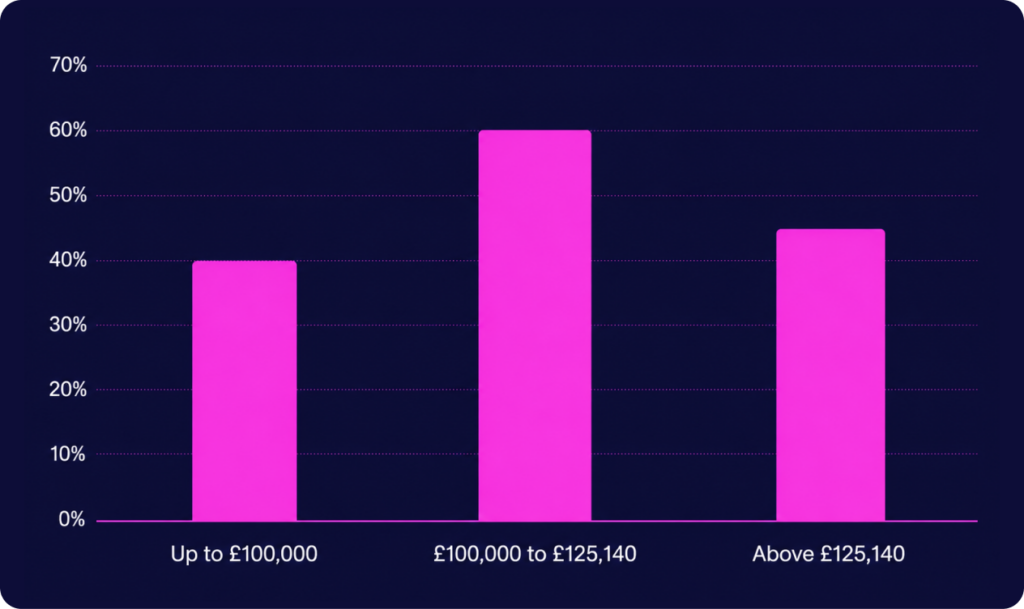
Figures are illustrative and based on current income tax and personal allowance rules. Your own effective rate depends on your individual circumstances and may change if tax rules change.
That hump in the middle is the whole story. The tax doesn’t keep climbing the more you earn. It actually eases off again once you’re clear of £125,140, which is the useful bit to hold onto: this is a narrow band worth planning around, and a pay rise into it is nothing to feel bad about.Figures are illustrative only. Your own numbers depend on your individual circumstances and may change if tax rules change.
Take Rachel, for example
A promotion took her from £92,000 to £108,000, backdated three months and paid as a lump sum alongside her March payslip. On £108,000, that meant losing £4,000 of her personal allowance, now taxed at 40% instead of sitting tax-free. Combined with the 40% she was already paying above £50,270, the slice of her income between £100,000 and £108,000 was effectively taxed at 60%, not 40%. It’s why a promotion that looked like £16,000 more a year translated into a few hundred pounds’ difference each month, once the numbers actually settled.
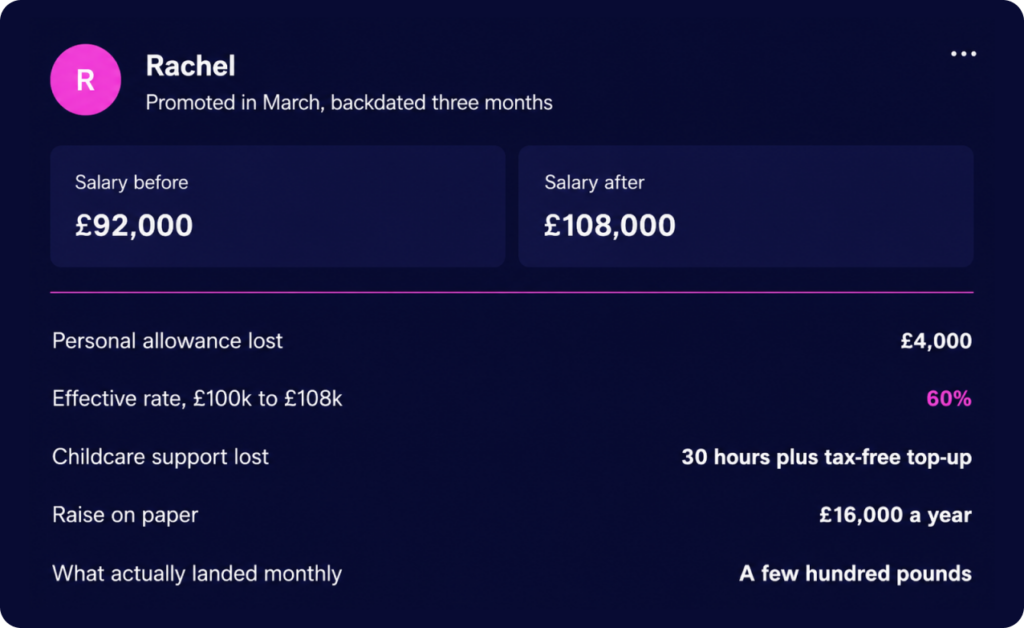
Figures are illustrative only. Your own effective rate depends on your individual circumstances and may change if tax rules change.
The bit that stings more: childcare
If you have young children, there’s a second trap sitting right on top of the first. Both 30 hours of funded childcare and tax-free childcare use the same test: adjusted net income of £100,000 or less, checked separately for each parent. There’s no taper here, no gradual reduction. Go a single pound over and the support can stop outright.
For Rachel, the harder blow wasn’t the tax, but the childcare. She and her partner had been relying on 30 hours of funded nursery care for their youngest, plus tax-free childcare on top. Her new salary put her over the line, and the funded hours and top-up payments, worth several thousand pounds a year, disappeared the moment her income crossed £100,000, regardless of how far over she was.
Why nobody sees it coming
Ask most people earning £108,000 what tax band they’re in and they’ll say 40%. Almost nobody would describe themselves as sitting in one of the most punishing income bands going, but that’s exactly where this one lives. It has no line on a payslip and no mention on the HMRC website. It only becomes visible once someone works out what actually happens to the next pound they earn, usually after a pay rise or bonus has already landed, much as it did for Rachel, whose promotion had already been agreed and backdated before any of this became clear.
Where this turns into an opportunity
This is one of the more fixable situations in personal finance, precisely because it’s so narrow and so well defined. You know exactly where the band starts and ends, and there’s a genuinely useful set of levers for managing how much income falls inside it.
Pension contributions reduce the income figure used for both the tax taper and the childcare test, which can pull you back under £100,000 entirely, effectively buying back your allowance and your childcare support in one move. The timing of a bonus or dividend can sometimes shift between tax years. If your partner earns less, splitting income between you can reduce how much sits in the taper zone.
What actually works depends on your full picture: salary, other income, existing pension contributions, and anything else changing that year. That’s exactly the kind of thing a financial adviser can model properly against your real numbers, turning a band that looks like a trap on paper into a straightforward planning decision.
Worth checking where you stand?
If your income sits anywhere near £100,000, or you’re expecting a rise or bonus that could push you over, it’s worth finding out how much of it falls into this band and what your options are. A financial expert from Octopus Money can walk through your numbers with you.
Talk it through with an expert
If you’d like to speak to someone directly, an Octopus Money expert can give you a clear picture of where you stand and what to do next.

Important information
If you’re matched with an FCA-regulated adviser, they’ll explain clearly which parts of any recommendation are regulated advice.
This article is for general information only and does not constitute personal financial advice. Tax rules can change and their impact depends on your individual circumstances. The value of investments can go down as well as up and you may get back less than you invest.
Some of our services are not regulated by the Financial Conduct Authority. Before you use any of our services, we will outline which of those services are and are not regulated by the Financial Conduct Authority to ensure you can make a fully informed decision. Octopus Money Limited is an appointed representative of Octopus Investments Limited which is authorised and regulated in the UK by the Financial Conduct Authority. Registered office: 33 Holborn, London EC1N 2HT. Registered in England & Wales under No. 14069098. Octopus Money is a trading name of Octopus Money Financial Solutions Limited. Registered in England and Wales (No. 10339119). Authorised and regulated by the Financial Conduct Authority. Our Financial Services Register number is 763630.
