
Blog
Why frozen tax thresholds could be costing you thousands

Every year, the government decides whether to raise the personal allowance and the higher rate threshold, the two numbers that decide how much tax you pay. Usually they rise in line with prices. Right now, they’re not. Both have been frozen since 2021 and are set to stay frozen until 2031, which is one way governments can bring in more tax without changing any of the actual rates.
As your pay goes up each year but those thresholds stay exactly where they are, more of your income ends up in the higher tax band, even though nothing about the rules has changed. There’s a name for this: fiscal drag. Here’s what that actually means.
Take David, for example
David’s 48, an operations manager, and gets a steady 3% pay rise most years. Nothing dramatic, no promotion on the horizon, just the normal kind of pay progression most people expect over time.
In 2026 he’s on £58,000, already just over the higher rate threshold, with £7,730 of that taxed at 40%. Run the same 3% rises forward and by 2031 he’s on around £67,200. The threshold hasn’t moved an inch, so now nearly £17,000 of his income sits in that band, more than double what it was.
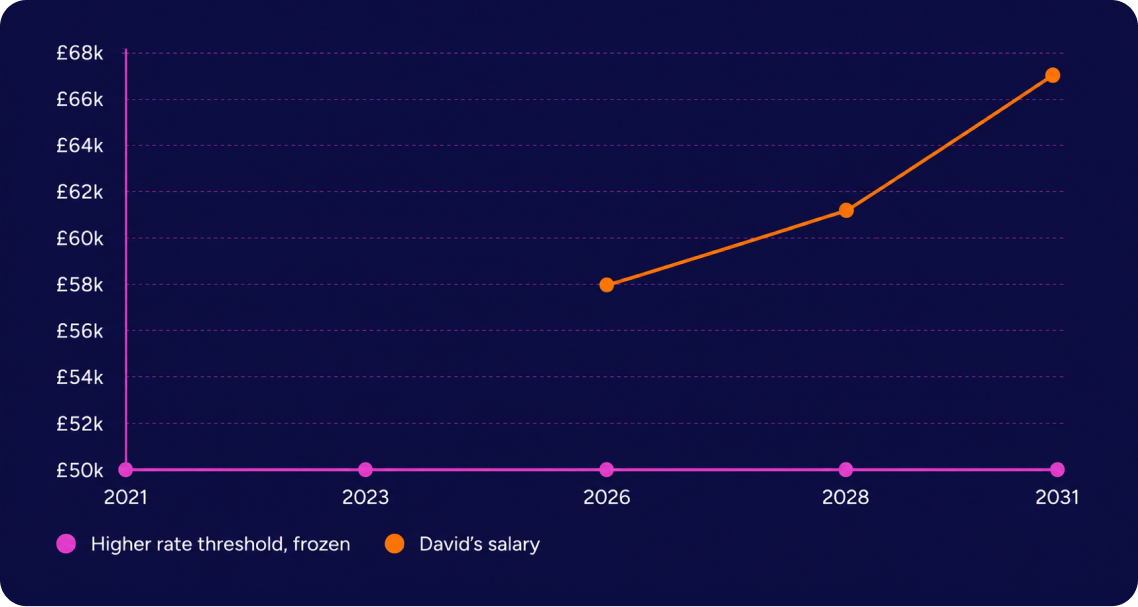
Figures are illustrative and based on current rules and a standard 3% annual pay increase. Individual circumstances may vary and rules may change.
Had the threshold risen with his pay instead of staying frozen, he’d be paying roughly £1,600 less tax in that final year alone, and over £4,700 less across the years in between. None of that comes from a policy change. It comes from David doing exactly what he’s always done, while the threshold stayed exactly where it was.
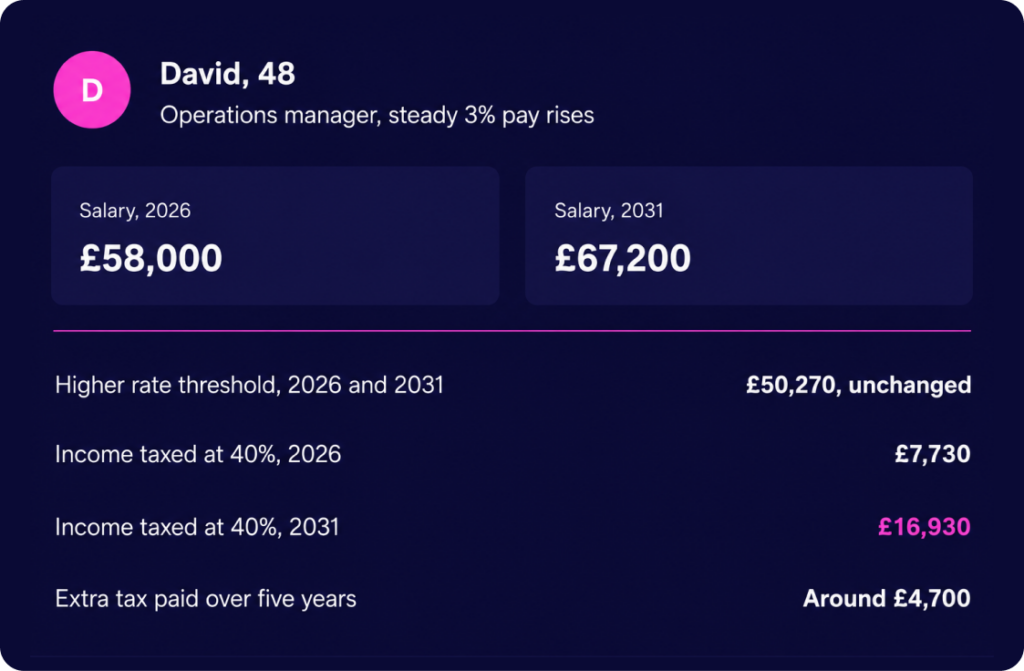
Figures are illustrative only. Your own numbers depend on your individual circumstances and may change if tax rules change.
Why the effect grows the longer the freeze continues
Each year the thresholds stay still while average wages move, a slightly larger share of income falls into the higher band than the year before. The freeze has already run since 2021, which means by 2031 it will have been a full decade of this happening year after year.
The table below shows how this builds using the same example salary and pay rises as before. Each column shows a snapshot a couple of years apart: the salary keeps moving, the threshold doesn’t, and the amount taxed at 40% grows each time.
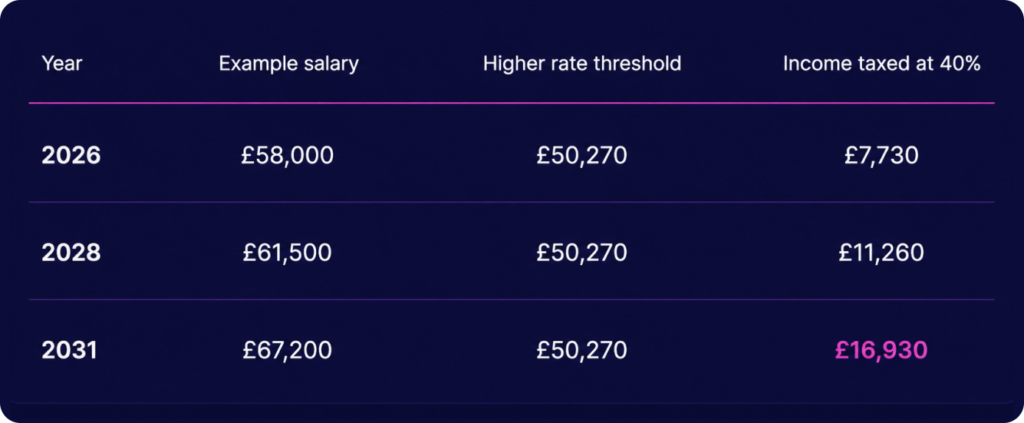
By 2031, more than double the amount of income sits in the higher rate band compared with 2026, without a single change to the tax rate itself.
How this shows up in real life
There’s no rate rise to spot on a payslip and no HMRC letter explaining what changed, because nothing has, on paper. The only way to see the real effect is by comparing this year’s tax bill with what it would have been if the threshold had risen alongside your pay. For most people, the extra tax just becomes part of the background, the way a forgotten subscription becomes part of the monthly outgoings without anyone noticing.
What you can do about it
The freeze itself is fixed, there’s nothing anyone can do about that bit. But how much of your income sits above that line each year is very much something you can influence, and it’s worth looking at now rather than waiting until 2031 to find out what it’s cost you.
Pension contributions reduce the income counted against the higher rate threshold in the first place. ISA allowances mean growth and income from those investments never enter the calculation at all. And if you’re part of a couple, drawing income between you rather than concentrating it with one earner can keep more of it below the higher rate band on both sides.
None of these are one-off fixes for a one-off problem. The freeze runs to 2031, so the planning needs to as well, reviewed regularly rather than set once and left.
Want to know what the freeze is actually costing you?
If you’d like to speak to someone directly, an Octopus Money expert can give you a clear picture of where you stand and what to do next.

Important information
If you’re matched with an FCA-regulated adviser, they’ll explain clearly which parts of any recommendation are regulated advice.
This article is for general information only and does not constitute personal financial advice. Tax rules can change and their impact depends on your individual circumstances. The value of investments can go down as well as up and you may get back less than you invest.
Some of our services are not regulated by the Financial Conduct Authority. Before you use any of our services, we will outline which of those services are and are not regulated by the Financial Conduct Authority to ensure you can make a fully informed decision. Octopus Money Limited is an appointed representative of Octopus Investments Limited which is authorised and regulated in the UK by the Financial Conduct Authority. Registered office: 33 Holborn, London EC1N 2HT. Registered in England & Wales under No. 14069098. Octopus Money is a trading name of Octopus Money Financial Solutions Limited. Registered in England and Wales (No. 10339119). Authorised and regulated by the Financial Conduct Authority. Our Financial Services Register number is 763630.
