
Blog
How to make your retirement money last (and actually enjoy it)

Here’s a question that catches a lot of people off guard: you’ve spent decades saving for retirement. Now what?
Most of the financial conversation up to this point has been about building your pot. But once you’re in retirement, or close to it, the challenge changes completely. The question is no longer how much you’re putting in. It’s about how you take it out, in what order, at what pace, and in a way that means it lasts as long as you need it to.
Here’s how that looks in practice.
Important reminder: This article is for information only and does not constitute personal financial advice. The value of investments can go down as well as up. Your actual retirement position will depend on your personal circumstances.
How long does your money need to last?
Retire at 65 and your money could need to last 30 years. That’s longer than most people’s entire working career, and might change how you should think about spending.
A useful rule of thumb is the 4% guideline. If you withdraw around 4% of your pot each year, this gives a well-invested portfolio a reasonable chance of lasting three decades.
On a £300,000 pot, that’s £12,000 a year. On £500,000, it’s £20,000.
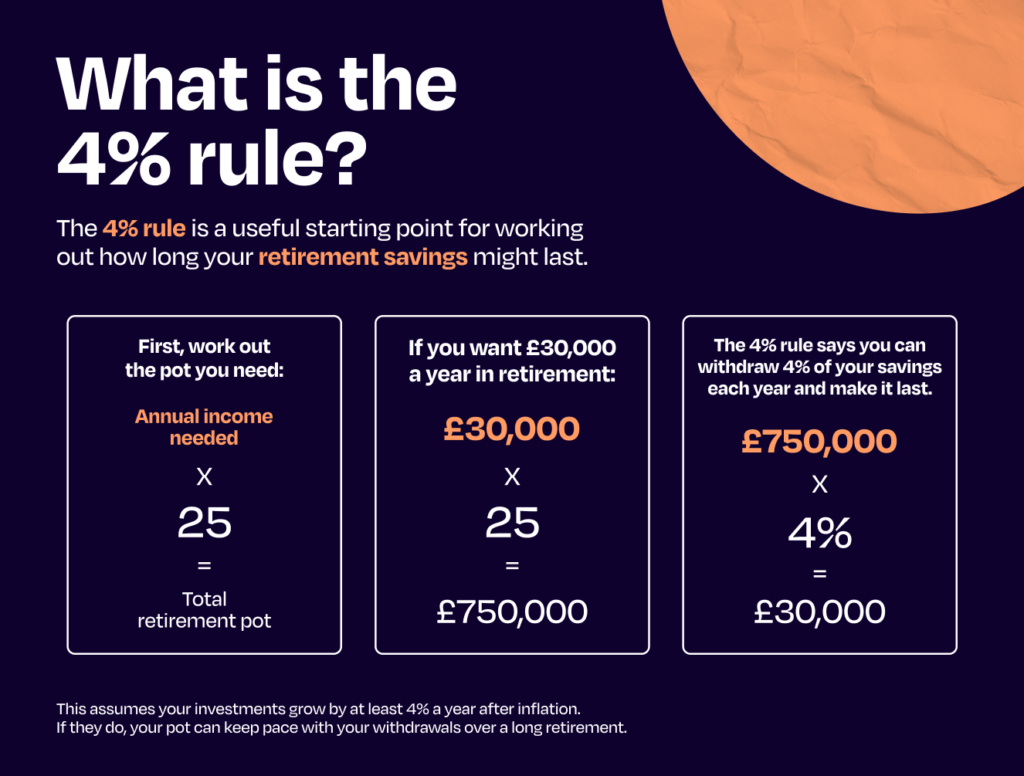
This is a starting point rather than a rule to live by. What matters just as much is what happens in those early years. A bad run in the markets right after you retire hits harder than the same dip ten years in, because you haven’t got time to wait it out. How your money is structured matters as much as how much you have.
Your State Pension: timing is everything
For many people, the State Pension is the foundation of their retirement income, currently worth around £11,973 a year if you have the full entitlement. But when you take it matters.
You don’t have to claim it the moment you’re eligible. Every year you defer increases your payments by around 5.8%. If you have savings to draw on in the meantime, waiting a year or two could mean a meaningfully higher guaranteed income for the rest of your life.
It’s worth checking your State Pension forecast if you haven’t already. The government’s online checker will show you what you’re on track to receive and when.
The order you spend matters
Think of your retirement savings less as one big pot and more as a few different pots, each with different rules.
As a rough guide, it usually makes sense to draw from your savings and investments before you touch your pension. Your pension keeps growing while you leave it alone, and because pension withdrawals are taxed as income, taking less from it each year can keep your tax bill down.
There’s another reason to leave your pension until later too. Unlike most other assets, pensions currently sit outside your estate for inheritance tax purposes. So the longer it stays put, the better placed it is.
Everyone’s situation is different, and the right order depends on what you have and how it’s set up. But it’s one of those things that’s worth getting right, because the difference over a long retirement can be significant.
Your money has three jobs now
A practical way to think about this is to split what you have into three buckets:
- Now: Money you need in the next 1 to 3 years. Accessible, low-risk, covers your regular spending and day-to-day costs.
- Soon: Money you’ll need in the next 3 to 10 years. Can take a bit more risk, but shouldn’t be exposed to big market changes.
- Later: Money you won’t need for 10 years or more. Can stay invested for growth. This is also where any legacy planning sits if that matters to you.
When you know your next few years of income is covered and sitting safely, a wobble in the markets feels a lot less stressful.
On actually spending it
Here’s something that surprises a lot of people: research consistently shows that retirees underspend. People who could afford a genuinely comfortable life hold back out of habit or anxiety, and end up with far more left at the end than they ever intended.
That might sound like a good problem. But unspent pension savings can face a 40% inheritance tax bill depending on how they’re held. And years of holding back when you didn’t need to is its own kind of loss.
It’s also worth knowing that spending in retirement rarely stays the same. Most people spend more in their active early years, less in the quieter middle period, and then costs can creep up again later if health becomes a factor. A plan that treats every year identically is usually more cautious than it needs to be.
Spending your savings isn’t a failure of planning. For most people, it’s the plan working exactly as it should.

So where do you stand?
The right withdrawal rate, spending plan, and drawdown order all depend on your numbers. Our retirement calculator shows where you stand and how long your money could last.

Talk it through with an expert
If you’d rather skip the calculator and speak to someone directly, an Octopus Money expert can give you a clear picture of where you stand and what to do next.
Important information
The initial free session with a coach or adviser does not include regulated financial advice or personal recommendations. If regulated financial advice may be appropriate for you, Octopus Money will explain what that involves and how it can be accessed separately. We will always clearly signpost when you are moving from a guidance session into a regulated advice session.
If you’re matched with an FCA-regulated adviser, they’ll clearly explain which parts of our service are regulated.
If you’re matched with a financial coach, they will not provide regulated financial advice or recommend specific products. You’ll receive guidance on possible next steps to help you understand your options.